
Tricky Light
23 Nov 25
A moment with perfect light! Wild horses of the Camargue in gorgeous sunset
Light, light, light – Good light makes an image. We all strive for wildlife images in glorious light. Typically, this means early morning and just before dusk, when a low sun creates a warm glow. But, it isn’t always that easy. Some animals are hard to catch in good light, either they thrive in the middle of the day – when light can be harsh - or they are in restricted areas where access is only possible during the height of the day. Some animals’ habitat is the dense jungle, where light can be at a premium. Other animals, particularly birds, like it high up in trees, where the background can be highly contrasty and heavily backlit. These are challenging photography conditions.
A Crested Serpent-Eagle deep in the rainforest of Borneo. Precious little light around apart from a soft shaft of light hitting the Eagle. A very slow shutter speed was possible as the bird was relatively still. Shot at 800mm @ f/6.3, 1/100s, ISO 3600.
Such situations are familiar to all wildlife photographers, and we strive to find shooting conditions to minimise the impact of tricky light. We cherish those moments when it all comes together: Glorious light, an interesting subject/action and a pleasing background. But we cannot always get what we want. Sometimes tricky light is the order of the day. Particularly, if you are in a place with limited access or where you are unlikely to return soon. You have encountered a new / exciting animal, and you have this one opportunity to get an image of a particular species. Working with tricky lighting conditions is sometimes unavoidable.
The noise of the pecking was the first indication of a bird deep in the Santubong jungle, Borneo. Spotting this Red-crowned Barbet took a bit of time. Finding an angle for a clear shot was even more tricky. The lack of light didn’t help. Even in the late morning it was very little light. A slow shutter speed was needed to keep ISO under control. Shot at 800mm @ f/6.3, 1/125s, ISO 3200.
Tropical rainforests are teeming with life, the noise tells you animals are everywhere. Spotting them can be trickier. The jungle is dense and dark, with huge and tall trees, thick canopies and impregnable foliage. Even at the height of the day, light struggles to penetrate, and if it does, it can create tricky and highly contrasty light to deal with. The lack of light means that the ISO values quickly skyrocket, resulting in noisy images. The shutter speed typically required to freeze animal action and secure a sharp image would likely render the image too noisy and unusable, even with a large aperture lens and today’s impressive camera sensors and post-processing software.
The squeaks were the first indication if its presence, but spotting this male Red-naped Trogon deep in the rainforest in Borneo was tricky. Patience was required to find an acceptable angle for a clear shot through dense foliage. Precious little light to play with even in the middle of the day. Shot at 800mm @ f/6.3, 1/250s, ISO 3200.
The trick here is to set the lens aperture wide open and the camera on continuous shooting at the highest frames-per-second setting. Use image stabilisation, and shoot short bursts of images of the subject, steadily decreasing the shutter speed as far as you think sensible - and even well beyond - until the ISO level is acceptable to you. Do this as long as the subject allows depending on its movements. Try to time your short burst with the animal’s activity, to coincide with a stop in its motion. With practice, this approach can be highly successful. Take as an example the Red-Crowned Barbet shot in the Santubong rainforest, Sarawak, where I managed to capture some sharp images at 1/125sec at 800mm. A faster lens, with a low maximum aperture, will help a lot in such situations, but those lenses are large (or too short in focal length for skittish jungle animals) and cumbersome when trekking through a dense rainforest.
The evening light was fading in a place with little light to start with in the Kibale rainforest, Uganda. A burst of images were taken and at least one came out sharp at an incredibly low shutter speed. Any ‘normal’ shutter speed would have resulted in too noisy ISO value. Shot at 400mm @ f/5.6, 1/20s, ISO 3600.
Another common situation faced by wildlife photographers is a subject in a tree against a bright sky. Apart from the challenge of being below the animal and shooting up towards the subject (e.g. the bird belly shot), the light can be tricky, with the subject often in the shadow and a bright sky behind it. The camera’s sensor cannot easily handle the contrast and wide dynamic range of the scene. You’re faced with a choice: Do you expose for the subject and blow out the sky? Or do you expose to retain detail in the sky, but render the subject significantly underexposed? There is no good answer, and every situation is different. In the latter case, depending on the dynamic range of the image, you can sometimes bring back the details in the subject in post-processing. In other cases, avoiding clipping the sky will render the subject just too dark to recover.
Just a little ray of light can make all the difference. Waiting for the wind to open up the foliage so that a ray of light hit the chimp’s face allowed for a safer shutter speed at a reasonable ISO level. Shot at 200mm @ f/5, 1/200s, ISO 1400.
So what is the solution, if you cannot recover the image sufficiently in post-processing? You could attempt to take two images of the subject, with one exposed for the sky, and one for the subject, and combine as an HDR merge in post-processing. However, a wildlife subject is seldom that accommodating, with movement between your two images making this a tricky post-processing manoeuvre. A different approach which I sometime use, when all other options have been ruled out, is to:
Focus on the subject and carefully expose for it. Ignore the fact that the sky will be blown out and rendered totally white without any detail
Then, ignore the subject and take a photo of the scene exposed for the sky. This second image’s sole purpose is to create a reference colour for the sky
Use a photo editing software which can handle layers, and create an empty layer behind the image layer (with the subject correctly exposed)
Sample the sky’s colour from the refence shot (with the sky correctly exposed), and fill the empty layer with this colour
Use luminosity masking to select the blown out (white) parts of the subject image and blend the two layers applying this mask. This turns the clipped sky into the actual colour of the sky when the images were shot. See the examples of the orangutang images from Borneo.
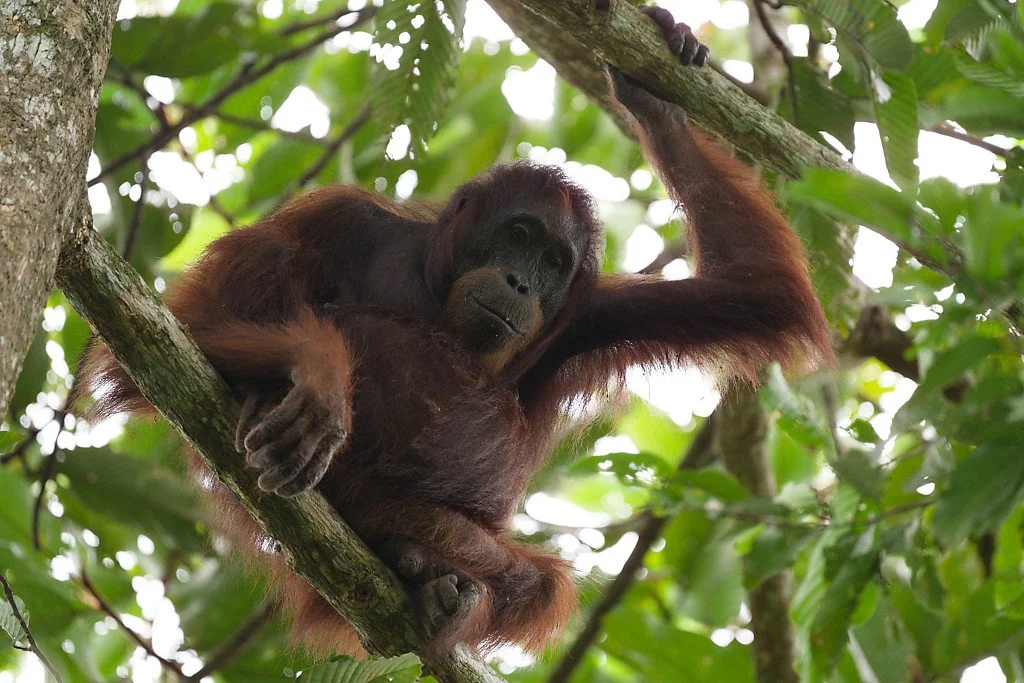
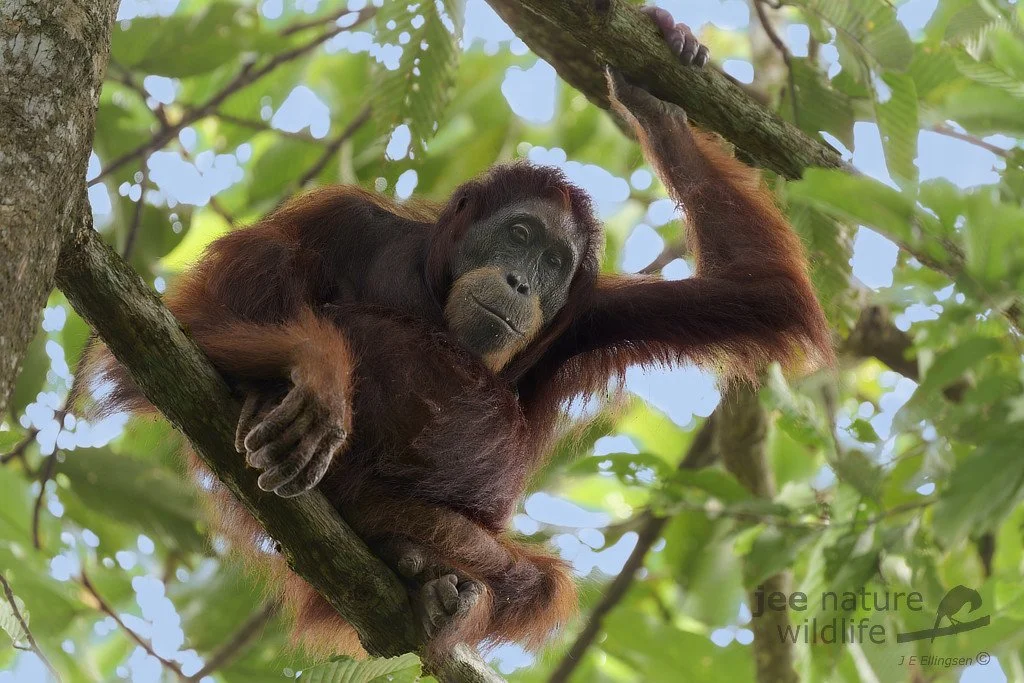
Click on the above image and use the arrow keys to switch between them and compare. The image is of a female Orangutang in the wild on the Kinabatangan river, Sabah, Borneo. Image exposed for the subject and the sky layered in during post processing. Shot at 800mm, f/6.3, 1/400s, ISO 1250.
Clearly, the best option is to avoid the bright sky altogether. Sometimes moving a few yards in one direction or backing up a bit can be enough to remove the sky and backlit areas from the composition. Or patiently wait for the animal to move into a better position. If possible, return to the location again, with better lighting conditions. But, when there is no other option, and this is the one chance to capture a species, tricky lighting situations can be overcome with a bit of planning in situ and effort in post-processing.
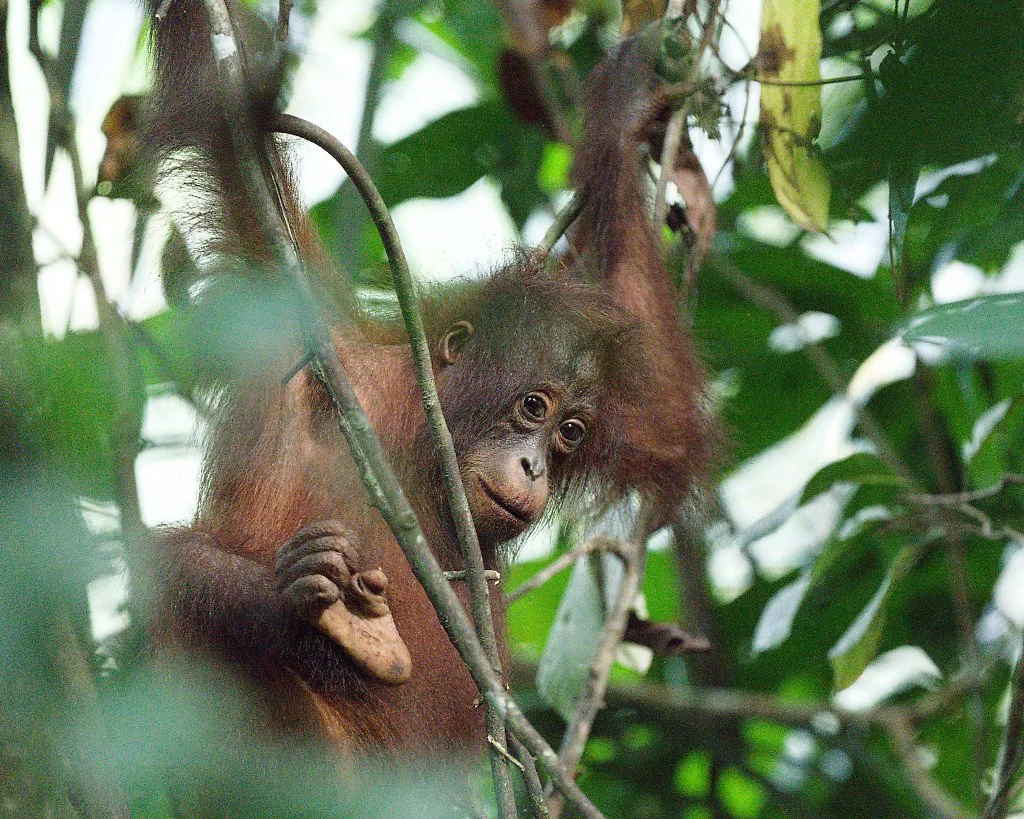
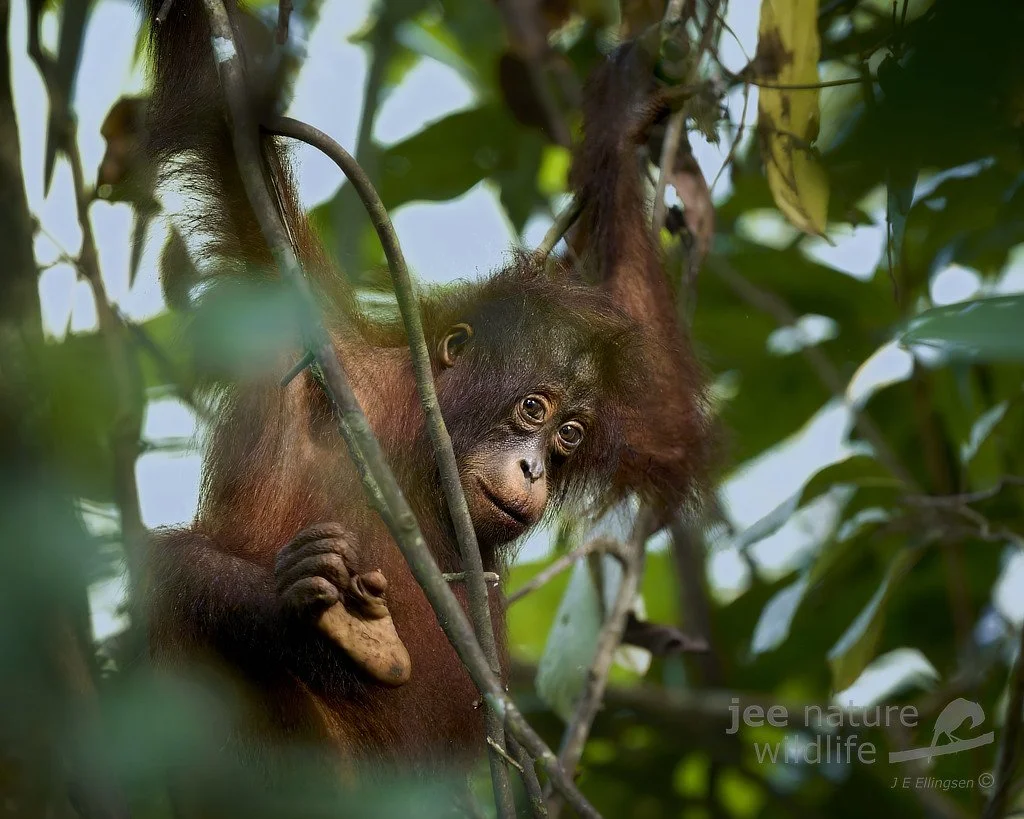
Click on the above image and use the arrow keys to switch between them and compare. A young Orangutang in the wild on the Kinabatangan river, Sabah, Borneo. Image exposed for the subject and the sky layered in during post processing. Shot at 800mm @ f/6.3, 1/800s, ISO 14400.